
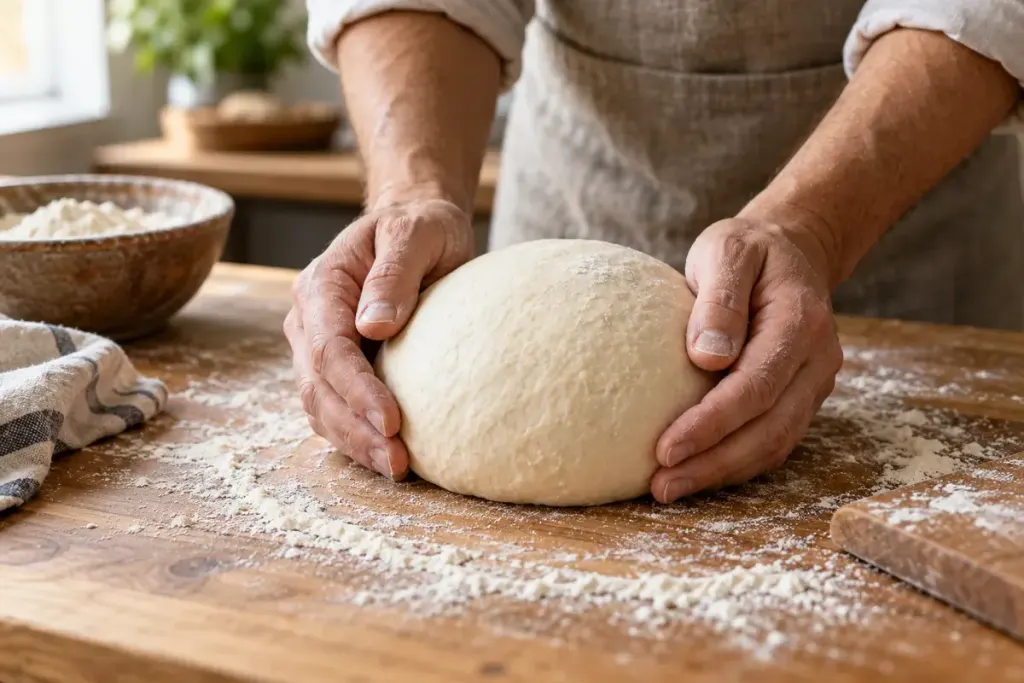
A piece of dough can look round while still spreading out the moment you release it. Shaping a boule is partly about arranging the dough, but it is also about giving the outside a little tension so the loaf can hold its form through the next stage.
King Arthur Baking’s boule-shaping demonstration shows several approaches. Its useful common thread is controlled contact with the bench: excessive flour makes the dough slide, while rough handling can tear the surface. Use the method alongside a bread recipe suited to this shape.
Set up a small practice area
Clear enough worktop to move both hands comfortably. Keep the scraper within reach and dust the surface lightly rather than creating a deep flour bed. If every movement sends the dough skating across loose flour, brush part of the bench clear before trying again.
Work with a pre-shaped round that has rested according to the recipe. A dough resisting every fold may need relaxation rather than another forceful pull. Dough formula, fermentation and temperature all affect its feel; one demonstration cannot supply an exact handling time for every loaf.
Watch the outside, not just the outline
As the recipe’s shaping method gathers the dough underneath, watch the upper surface become smoother. Stop periodically and release your grip. Does the round hold together? Is the surface intact? More passes are not automatically better. Once a skin begins splitting, continuing the same movement harder will not repair the cause.
A useful learning exercise is to record one observation after each bake: how much bench flour you used, whether the dough dragged gently or slid freely, and whether the surface tore. Change one handling detail next time. That produces a more informative comparison than changing the recipe, fermentation time and shaping method together.
Transfer the shaped loaf into its prepared support as the recipe directs, then continue the final proof. Shaping does not replace fermentation, and a tidy ball is not proof that the dough is ready for the oven. Treat roundness, surface condition and proofing as connected observations with separate jobs.