
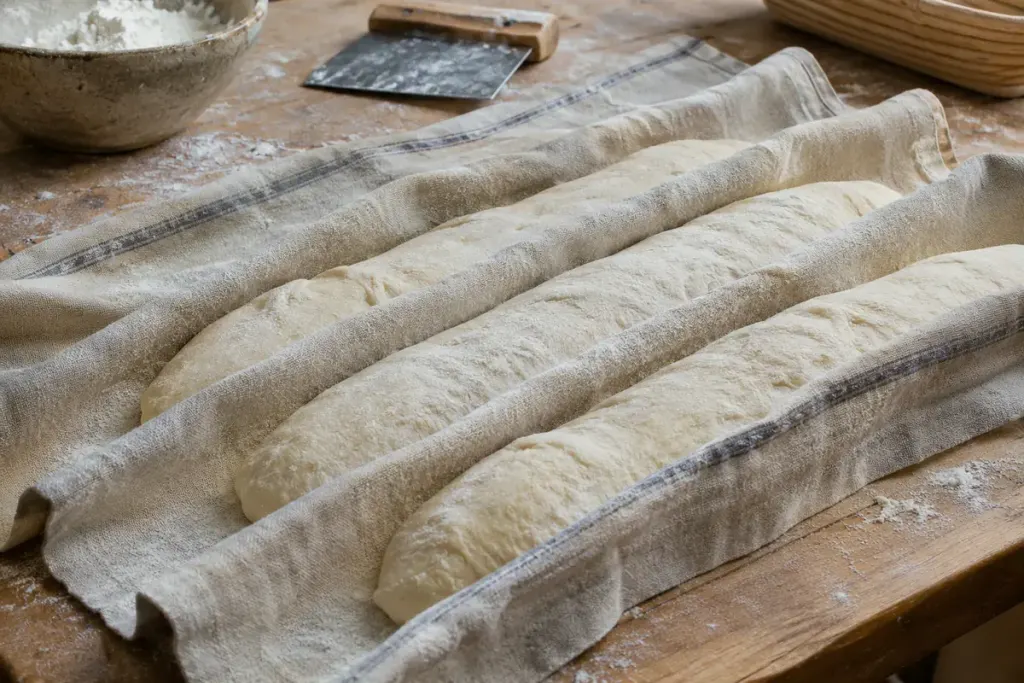
The awkward moment in baguette baking often arrives before the oven: a long, airy piece of dough needs to move without being stretched into a different shape. A baker’s couche helps during proofing, but its usefulness depends on planning that next movement.
A couche is a proofing cloth, commonly sturdy linen. Its folds support the sides of neighbouring loaves. King Arthur Baking’s baguette guide shows this arrangement alongside the tools used to transfer and bake the dough.
Give each loaf its own fold
Prepare the cloth according to its maker’s directions before the shaped dough is ready. Flour the contact surface and raise a fold between the pieces. Leave space for expansion; pressing the cloth tightly against a baguette defeats the point of giving it room to rise.
The cloth supports shape rather than deciding fermentation. Continue to judge readiness by the recipe and the dough’s condition. A neat row of supported loaves can still be underproofed or overproofed.
Rehearse the empty transfer
Before handling the dough, put the transfer board and baking surface within reach. Work out which side of the cloth will lift and where the loaf will land. This little rehearsal is particularly useful in a narrow kitchen, where the only clear counter may be behind you.
The manufacturer’s couche instructions distinguish proofing on the cloth from transferring the baguettes for baking. Do not treat a proofing cloth as an oven liner.
If dough sticks, pause before pulling harder. Identify the attached patch and release it gently with a suitable scraper. For the next bake, note the flour coverage, dough hydration and proofing time. Changing all three at once makes it difficult to learn what helped.
A useful practice note is short: “The middle loaf stuck near its seam; the end loaves released.” That observation tells you more than “the couche failed.” Finish by drying and caring for the cloth as instructed, so a successful bake does not leave damp fabric folded away for the next session.