
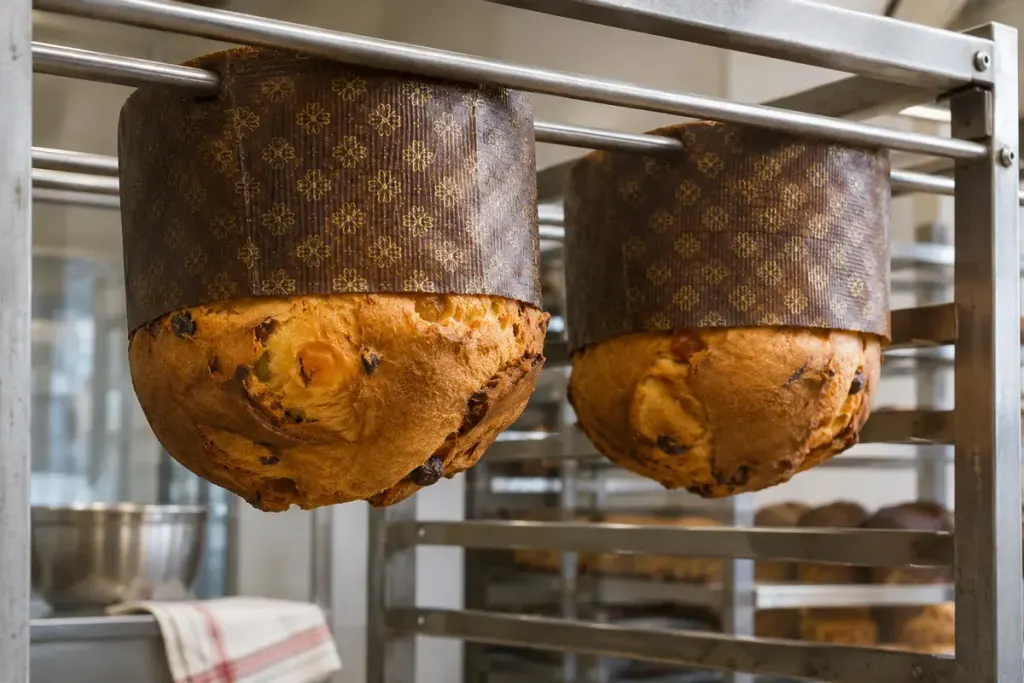
A bakery rack full of upside-down panettone looks like a practical joke until you consider the loaf inside each paper mould. A tall, richly enriched bread has to support a great deal of delicate crumb while it is still hot. Cooling is part of making the loaf, not just the wait before eating it.
The San Francisco Baking Institute’s panettone lesson explains why these loaves are suspended after baking: their rich, fragile structure can collapse under its own weight. Inverting the loaf supports its shape while the crumb sets and cools.
Prepare the landing place first
The awkward moment is discovering, with a hot loaf in your hands, that your cooling arrangement is too narrow or unstable. Read the complete recipe before mixing. Check the specified mould, support rods and suspension method, including whether the rods are fitted before or after baking.
Set up the support on a stable surface away from passing hands. Allow enough clearance for the entire inverted loaf. A rack that holds a small test loaf may not safely hold a much heavier one. Follow the equipment and recipe instructions rather than balancing sharp skewers across whatever containers happen to be nearby.
Cooling time belongs to the recipe
There is no single duration that fits every panettone size and formula. Maina describes a lengthy inverted cooling stage in its own production process; that is evidence of the stage’s importance, not a universal timetable for a home recipe.
Leave the paper mould in place when the method calls for it. Resist cutting the loaf early to inspect the crumb: the slice changes the support and gives a poor picture of how the finished bread would have settled.
For your baking notes, record the dough quantity, mould dimensions, baking endpoint specified by the recipe, and cooling arrangement. If the loaf sinks, those details help separate a cooling problem from issues earlier in mixing, proofing or baking. Hanging a loaf cannot rescue every structural fault.
Once the panettone is fully cool, package it as the recipe directs. Planning this last stage before starting the first makes the whole bake calmer—and gives the airy crumb a better chance to reach the table intact.