
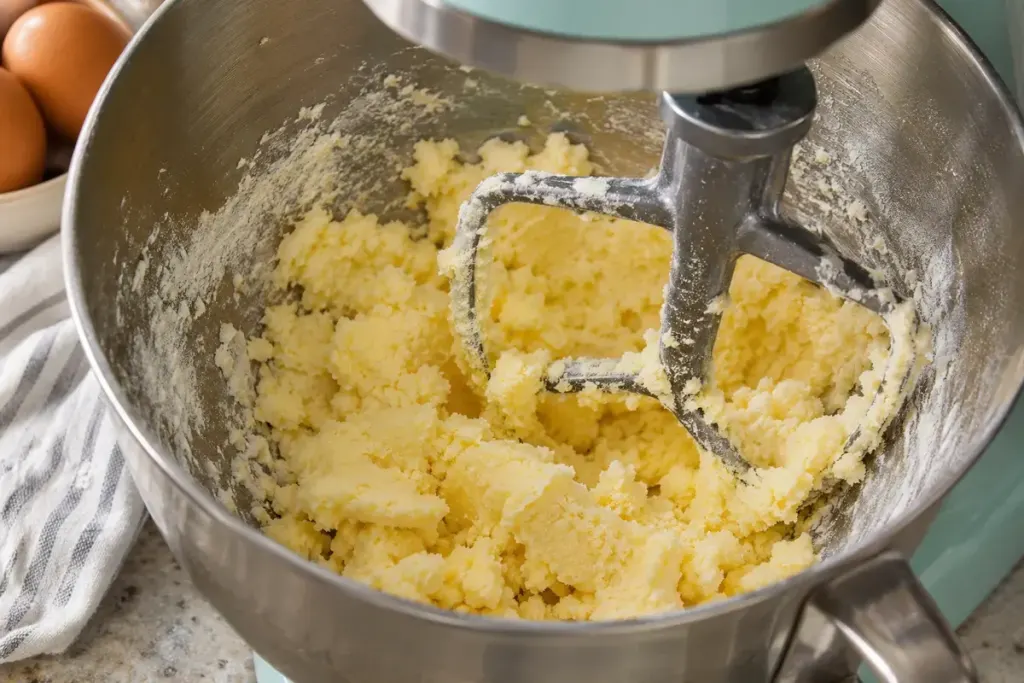
If a cake recipe tells you to add butter to the dry ingredients, resist the urge to correct it. Reverse creaming deliberately changes the familiar butter-and-sugar sequence. The early mixture can look sandy rather than fluffy, and that appearance is part of the method.
King Arthur Baking’s explanation describes coating flour with fat before much of the liquid arrives. This limits gluten development and helps produce a fine, tender crumb. It is a method built into a recipe’s balance and mixing instructions, rather than a universal upgrade for every cake.
Read the stages before switching on the mixer
Have the butter at the consistency specified by the recipe. Large cold pieces are difficult to distribute; melted butter is not an equivalent substitute. Combine the dry ingredients as directed, then add the butter and watch for an evenly textured mixture. Scrape the bowl where needed so a pocket of untouched flour does not survive beneath the paddle.
The later additions matter too. Some formulas add part of the liquid before gradually adding an egg mixture. Follow that particular sequence and its mixing times. “Avoid overmixing” is not an instruction to stop before the ingredients have become properly incorporated.
A useful first-bake notebook
For your first attempt, keep the recipe, tin and ingredient brands unchanged. Record three observations in your own words: how soft the butter was, whether the dry-stage mixture looked uniform, and how the cooled slice held together. A photograph of the cut crumb can be more useful than a note saying only “nice cake”.
For example, you might record a close crumb that cuts neatly but feels dry at the edges. That observation gives you something specific to investigate next time, rather than blaming the mixing method for every aspect of the result.
Let the cake cool before judging its final texture. If you want to compare reverse creaming with another technique, use recipes designed for each and recognise that differences in their formulas also influence the result. Changing the method, flour and pan together makes the lesson much harder to identify.