
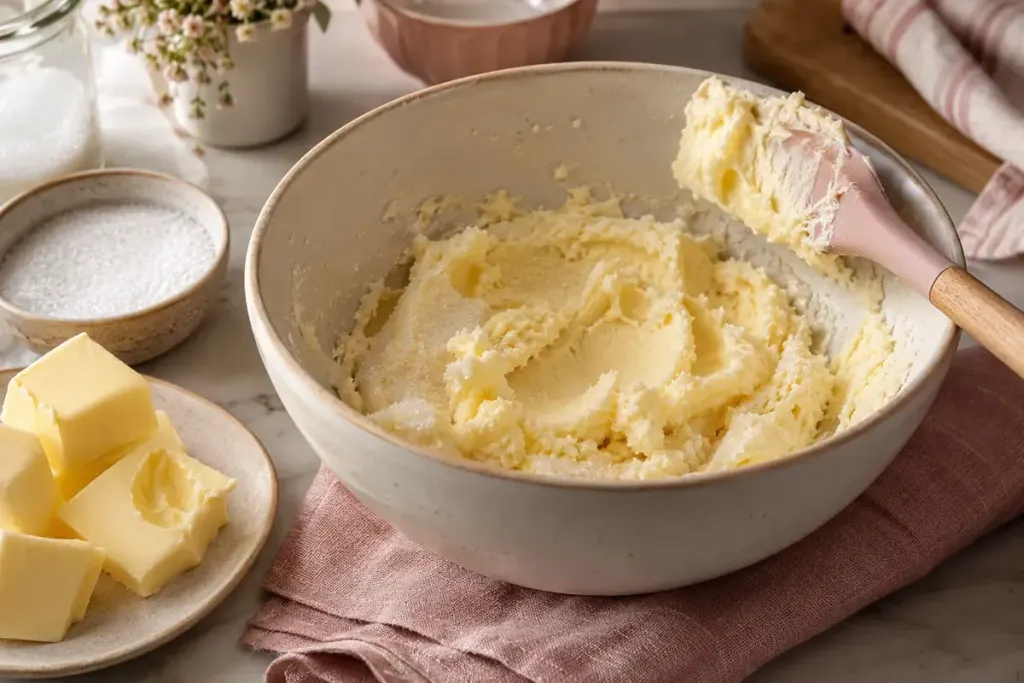
The recipe says to cream the butter and sugar. Five minutes later, the mixture still looks heavy. Before increasing the mixer speed, look at the butter you started with. Time cannot compensate reliably for the wrong texture.
King Arthur Baking’s creaming guide explains that sugar helps introduce air into butter. Butter should yield to a fingertip while retaining some resistance; a greasy puddle and a rigid block are both poor starting points. The finished mixture should look lighter and more aerated.
Make a short observation, not a guess
Before switching on the mixer, press the butter gently with a clean fingertip. Note whether it dents, smears or cracks. The word “room” in room temperature is not a measurement: a cool winter kitchen and a sunny counter can give very different results.
Check that your recipe actually uses a creaming method. Recipes calling for melted butter, rubbed-in pastry or an all-in-one mixing method have different intentions. Substituting a technique because it worked for another cake can change the result.
Use three stopping points
- Before mixing: check the butter and confirm the correct sugar, quantities and mixer attachment in the recipe.
- During mixing: stop the machine before scraping the bowl. Look for dense butter hiding at the bottom or on the sides.
- Before adding the next ingredient: compare the whole mixture, not just the pale layer near the beater.
Keep fingers and spatulas out of moving beaters. If the mixture has become greasy or unusually warm, pause and reassess rather than beating indefinitely. Return to the recipe’s visual instructions before proceeding.
A baking note that helps next time
Try a five-line record: recipe and batch size; butter texture at the start; mixer and attachment; appearance before the eggs; cooled cake texture. A note such as “butter hard at centre, dense streak remained after scraping” is more useful than “cake did not work.”
Change one variable on the next bake. If you replace the flour, alter the pan and change the creaming method together, you will have little idea which difference mattered. This is a home observation exercise, not a controlled laboratory test.
Do not chase perfectly smooth sugar
The aim is not to keep beating until every visible grain disappears. Follow the recipe’s endpoint and examine the texture. Baking becomes easier when the instructions describe something you can recognise.
Pastry asks different things of butter. For an example of why method matters, see how to read a pastry shell during blind baking.