
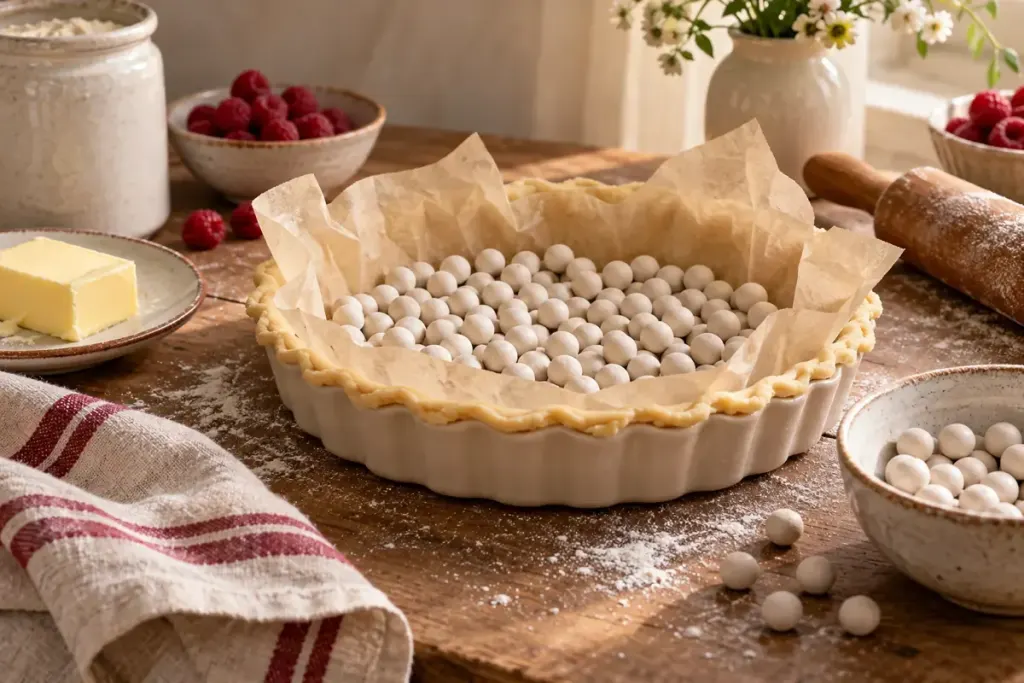
A beautifully coloured rim can hide a pale, damp-looking base. When blind baking, the question is not simply whether the pastry has spent enough minutes in the oven. It is whether the empty shell has reached the stage required by the filling.
King Arthur Baking’s guide to blind baking describes pre-baking a crust before filling it, using support during the early bake and returning it to the oven after removing that support. Its worked recipe is a reference, not a universal temperature schedule for every dough and tin.
Read the filling instructions first
Will the filled tart return to the oven? Or will a cooked or chilled filling go into a completely baked shell? Mark “partial” or “full” at the top of your preparation note, following the chosen recipe. Otherwise, it is easy to make a sound pastry shell that is wrong for the next step.
Check the actual tin size as well. A deeper tin, thicker dough and a different pan material are reasons to pay attention, not reasons to invent a time adjustment without checking the recipe.
Prepare the work area before the hot tin comes out
- Have a heatproof resting place ready for the tin.
- Use the lining and baking weights specified for the method.
- Leave enough accessible lining to lift the weights safely.
- Keep a heatproof container nearby for the removed weights, which remain hot.
A little organisation matters here because the second stage often begins while everything on the tray is still hot. Lift carefully; do not tip loose weights towards your hands or balance a hot tin at the edge of the counter.
Inspect three areas
The rim: record its colour. The sides: look for slumping or areas that have pulled away. The base: after the weights are removed, look for its degree of colour and any puffed areas. Interpret all three against the recipe’s expected endpoint.
Do not make holes in a shell automatically: follow the recipe, particularly where a fluid filling could leak. If the edge is colouring too quickly, use the recipe’s recommended protection rather than assuming the whole shell is finished.
Keep the diagnosis modest
One disappointing tart does not prove that the oven is faulty. Note dough thickness, chilling time, pan type and the appearance at each stage. On the next attempt, change one likely cause and compare. Photographing the empty shell can be a useful reminder after the filling covers the evidence.
Serve according to the filling recipe’s cooling and storage instructions. The reward for careful blind baking is practical: a base that supports the filling as well as the rim promises it will.