
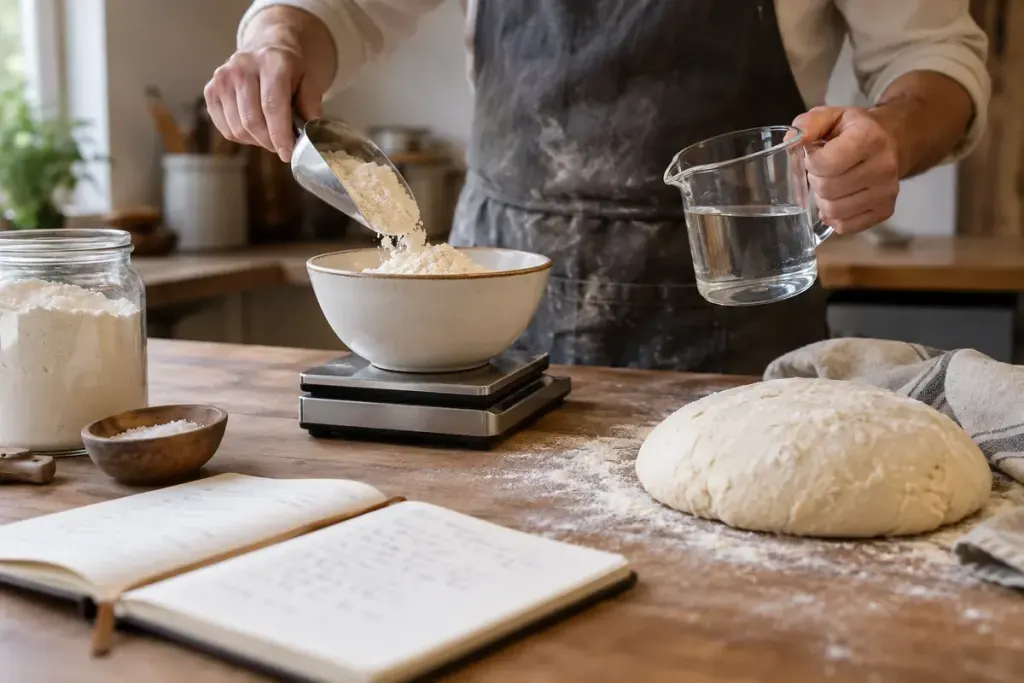
A dough formula showing flour at 100% and water at 65% is not claiming that the ingredients add up to 100. In baker’s percentages, flour provides the reference weight. Every other ingredient is expressed as a proportion of that flour, which makes the formula useful at several batch sizes.
King Arthur Baking’s explanation of baker’s percentage sets out this flour-based convention. It works by weight, so a scale is much more useful here than a set of cups.
Suppose a demonstration formula uses 500 grams of flour, water at 65%, salt at 2% and yeast at 1%. Water is 325 grams, salt is 10 grams and yeast is 5 grams. The total is 840 grams. This is an arithmetic example, not a complete recipe: yeast type, temperature, fermentation and flour still need appropriate instructions.
To make the same proportions with 300 grams of flour, multiply each percentage by 300 instead. You get 195 grams of water, 6 grams of salt and 3 grams of yeast. Keeping a separate column for actual weights makes this easier to check while mixing.
Keep the denominator consistent
If the flour blend contains white and wholemeal flour, combine their weights before calculating the other percentages. The flour components together make the 100% reference. Do not assign each flour its own independent 100% and then calculate the water twice.
Preferments introduce another bookkeeping step because they bring flour and water into the dough. Count those contributions when calculating overall hydration. Milk, eggs and other ingredients require more care than treating their entire weight as plain water.
Write both the percentage formula and the final weighed quantities in your baking notebook. The percentages preserve the relationship; the gram column tells you what actually belongs in today’s bowl.