
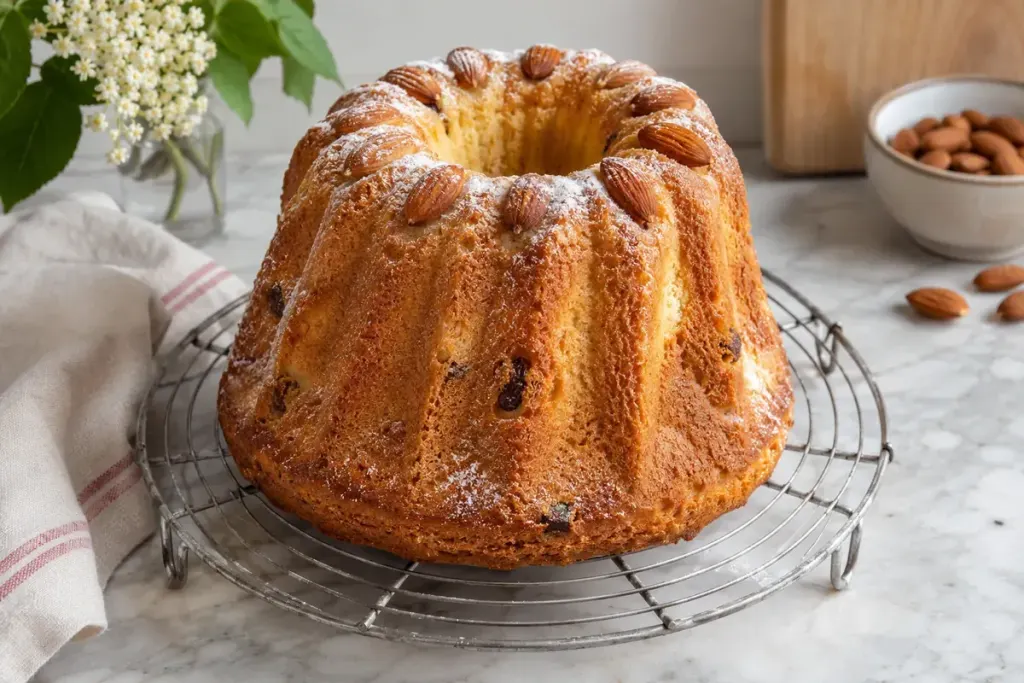
The tall ribs of a kouglof make it look like a cake that belongs on a special stand. Before it reaches that stand, however, it behaves like an enriched yeast dough: it needs development, fermentation and room to expand. The mould gives that process a distinctive shape.
Names and recipes vary across regions. The James Beard Foundation’s kugelhopf recipe uses a buttered mould with almonds and a dough containing eggs and raisins. King Arthur Baking’s naturally leavened version demonstrates a different fermentation schedule. Choose one complete formula for a first attempt; borrowing the timing from one and the leavening from another makes the result harder to judge.
Check the mould before mixing
A similar-looking ring tin may hold a different volume. Compare the capacity and dimensions specified by the recipe with your actual mould, including the central tube. A shallow ring cannot simply accept the quantity intended for a much taller vessel.
Prepare the flutes deliberately. Rotate the mould under a light and look for dry patches instead of assuming a quick swipe of butter has reached every recess. If almonds are part of the formula, arrange them before the dough goes in. Once baked and inverted, those details become the visible top.
Keep the ring even
Distribute the dough around the tube without leaving one side markedly thicker. King Arthur’s method forms an opening in the dough before lowering it into the mould; its specified final rise is judged against the rim as well as the clock. Follow the cues for the formula you selected, since a sourdough schedule is not interchangeable with a commercial-yeast schedule.
For your baking notes, record the mould, dough weight and appearance at loading. A quick photograph before baking is more informative than “rose for two hours.” If the finished loaf is lopsided, that record helps separate uneven loading from later expansion. Let the bake release and cool according to the recipe before slicing, so the first cut shows the crumb rather than damage caused by an impatient unmoulding.