
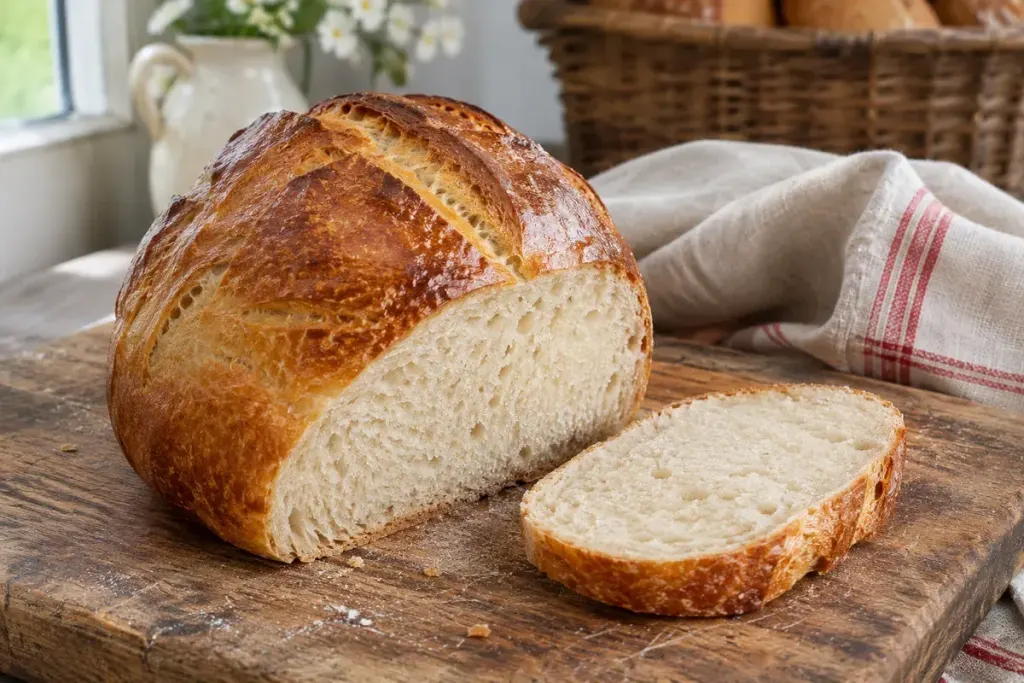
Not every good loaf needs large, irregular holes. Pain brié offers another pleasure: a close crumb that can carry a neat slice of butter without losing it through the bread. Understanding that intention changes how you approach the dough.
The Normandy bread’s name refers to a particular way of working it. The Espace Pain Information guide to regional breads describes compression and folding with a brie, a tool used to work the dough and expel air. This is a different starting point from trying to preserve every large bubble in an airy loaf.
Choose one version before changing its hydration
Recipes bearing a traditional name can use different home adaptations. Marie-Laure Fréchet’s published home method, for example, uses a poolish and a stand mixer. It is not an instruction to reproduce a historical bakery’s equipment. Read the flour, preferment and kneading directions together before deciding that the dough needs an extra splash of water.
For a first attempt, keep a short record of the flour used, the dough’s feel after mixing and its appearance after proofing. Photograph the cut loaf after cooling. These observations give the next bake something concrete to improve; “not enough holes” may simply be the wrong target.
Close does not have to mean gummy
Examine more than the size of the cells. Does the cooled slice hold together cleanly? Is there an unusually wet band near the base? Was the loaf cut while the centre was still hot? A dense-looking slice and an underbaked centre are not interchangeable descriptions.
Use the chosen recipe’s shaping and baking method, and follow the appliance maker’s limits when mixing a firm dough. Forcing a struggling domestic mixer is not a test of authenticity.
Serve a plain slice before adding a topping. Notice the crust, the resistance of the crumb and how the bread cuts. That small tasting exercise gives pain brié a fairer assessment than comparing it with a bread designed to have an entirely different interior.