
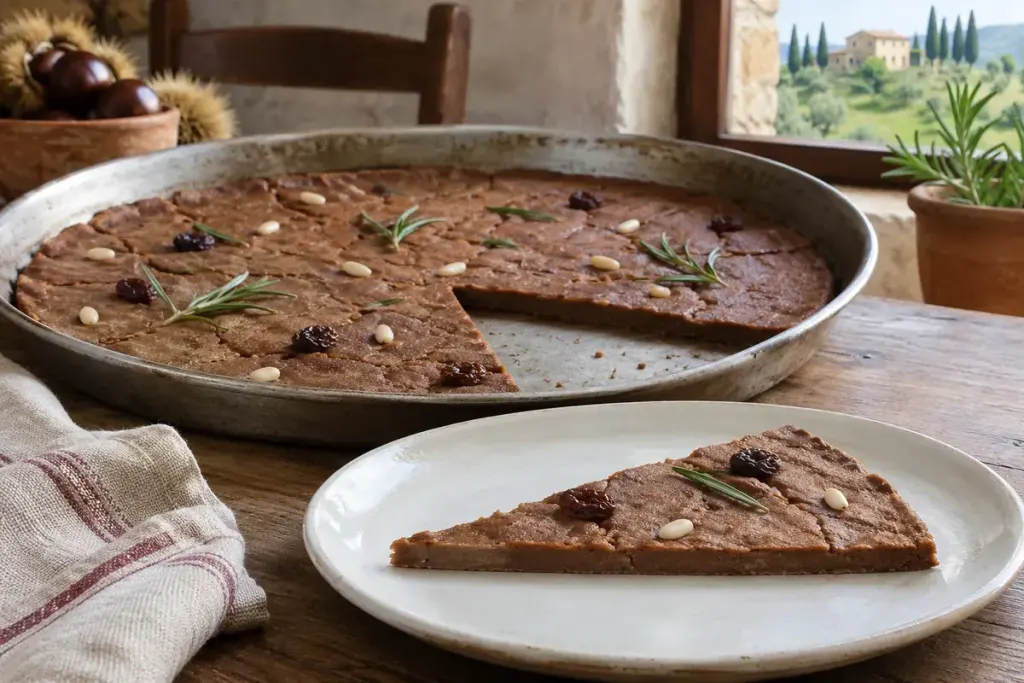
A slice of castagnaccio can surprise anyone expecting a tall, sweet sponge. Its appeal is a low, dense chestnut base, an olive-oil finish and small contrasts of nuts, dried fruit and rosemary. Understanding that identity helps you judge the bake on its own terms.
Visit Tuscany’s castagnaccio recipe combines chestnut flour with water and olive oil, using raisins, pine nuts, walnuts and rosemary. It is a useful reference for a cake that does not depend on the familiar flour-butter-egg sponge structure. Individual household versions vary, so choose one complete recipe before assembling ingredients.
Look at the slice, not its height
A low profile is part of the intended result. Do not add a raising agent simply because the batter looks unlike your usual cake mixture. Nor should a darker, close crumb automatically be treated as a failed vanilla sponge: the ingredient and texture expectations are different.
For a first attempt, keep the recipe’s pan dimensions alongside its ingredient quantities. Changing to a smaller pan while keeping the same batter changes the depth; a familiar baking time then becomes less informative. Write down which pan you actually used rather than recording only the oven setting.
A small tasting exercise
Cut a modest piece and try three bites: one from the centre, one with rosemary, and one with a raisin or nut. This is an observation exercise, not a scoring system. Notice which impression comes from the chestnut base and which arrives from a topping. It can help you decide whether your next version needs a different balance of additions rather than more sugar throughout.
When comparing recipes, compare their whole structure. One may distribute fruit within the batter while another emphasises the surface. Borrowing only the water quantity from one and the flour quantity from another gives you an untested formula.
Serve it with its name and a short description. “Tuscan chestnut cake with rosemary” prepares a guest for its character far better than promising a conventional fluffy cake. Check individual ingredients and preparation conditions before describing any batch as suitable for a particular allergy.