
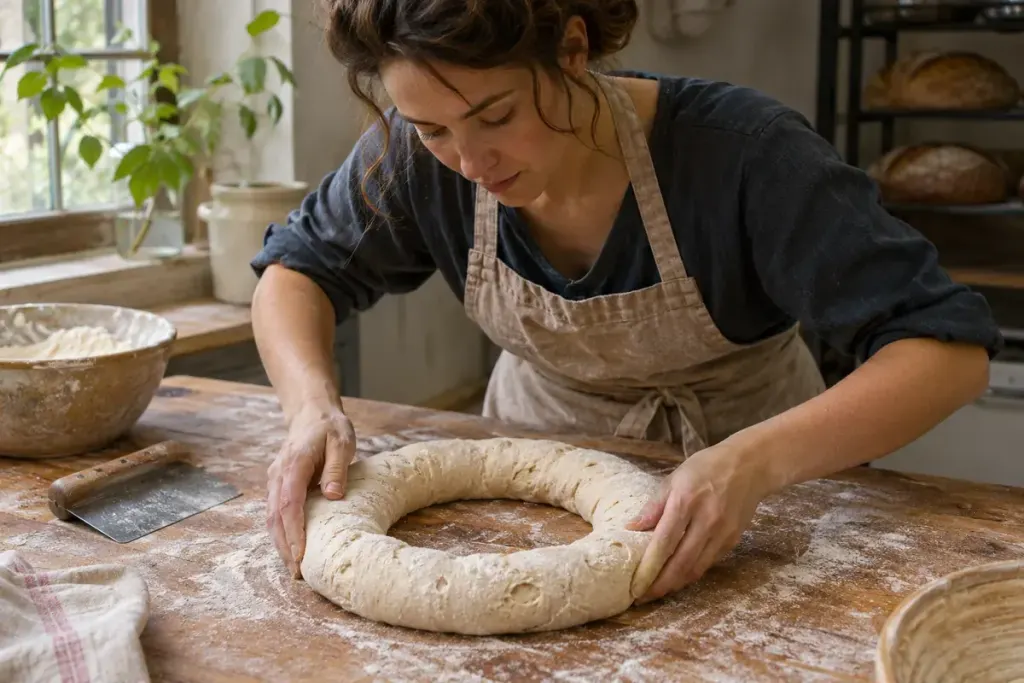
A ring of bread dough can look beautifully open on the bench and almost closed by the time it leaves the oven. A couronne asks you to plan for expansion towards the centre as well as outwards. The empty space is part of the shape, not simply the bit left over after arranging the dough.
There is more than one way to make a ring-shaped loaf. King Arthur Baking’s couronne method uses separate dough balls and a thin disc draped around the centre of a ring mould. The disc folds over the balls, producing a distinctive lifted edge after the loaf is turned out and baked. Follow that method’s full formula and sequence if you want that particular crown.
Decide how the centre will be supported
Before mixing, check the recipe’s shaping equipment and the space available on your baking surface. A proofing mould and a baking tin do different jobs. An improvised item suitable for supporting dough at room temperature is not automatically oven-safe.
For a first attempt, a small planning sketch helps. Mark the centre, the intended dough portions and the direction in which the loaf will be turned out. This catches an easily missed detail: some crown methods are assembled upside down. The surface facing you during shaping may become the underside.
Keep the portions reasonably even so that one large section does not push into the opening while smaller sections lag behind. Use the recipe’s handling guidance rather than adding large amounts of flour solely to make the dough easier to arrange.
Record the shape at three stages
- Photograph the shaped crown before its final rise.
- Photograph it again just before transfer, including the centre opening.
- Once cool, photograph the finished loaf from above and across a cut section.
Those pictures separate a shaping problem from a transfer problem. If the opening was already nearly closed before baking, the oven did not create the whole change. If the crown was distorted only while turning it out, improve release and handling before changing the dough formula.
Change one part of the process on the next bake. A wider initial opening, more even portions or a calmer transfer is easier to evaluate separately than a completely new recipe and a new mould at the same time.