
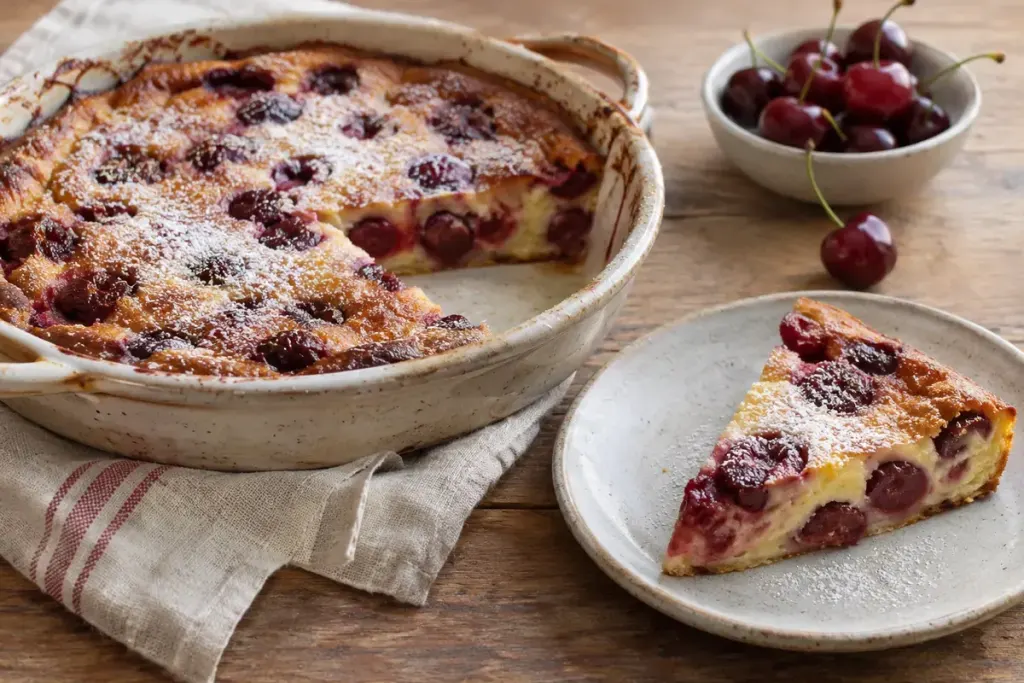
A clafoutis can rise impressively in the oven and then settle as it cools. If you were expecting a sponge cake, that change might look like failure. In this fruit-filled French bake, a relatively fluid batter sets around the fruit into something closer to a firm custard or thick baked pancake.
That expectation changes how you prepare the dish, read the centre and judge the finished slice. The aim is a tender, set interior, not a high, airy crumb.
Let one tested recipe set the proportions
Eggs, milk, flour and fruit appear in many clafoutis recipes, but the ratios are not interchangeable. King Arthur’s cherry clafouti uses a single fruit layer and a smooth batter, with a two-stage oven temperature. It also gives a mostly clean tester as a doneness cue. Other formulas can specify a different finish, so avoid borrowing one recipe’s timing for another recipe’s batter.
For a first attempt, keep the pan dimensions and fruit quantity unchanged. A deeper dish can leave the middle behind while the perimeter already looks well cooked. A much wider one makes a thinner bake and changes the balance between fruit and batter.
Three observations worth making
- Before pouring: check that fruit is distributed rather than heaped in one wet corner. If using pitted cherries, check for any missed stones.
- Near the end: inspect the centre as well as the browned rim. Follow the chosen recipe’s tester or set cue; a pretty edge does not prove that the middle is ready.
- After the rest: notice how cleanly the portion lifts and whether the texture is tender. Do not assess the structure only in the first moment out of the oven.
A centre that still runs like raw batter is different from a soft set. Likewise, a slice that is pleasantly tender need not resemble a dry cake crumb. Naming the texture makes the next adjustment more useful.
Change the fruit thoughtfully on the next bake
If the original version works, try one variation at a time. Record the fruit, its preparation, the pan and the time at which you first checked the centre. Frozen fruit, very ripe pears and fresh cherries do not arrive with identical moisture or shape.
Serve according to the recipe, and refrigerate leftovers promptly rather than leaving an egg-and-milk dessert on the table for the rest of the day. The best first result is a bake you can recognise and repeat—not one that happens to look tallest through the oven door.