
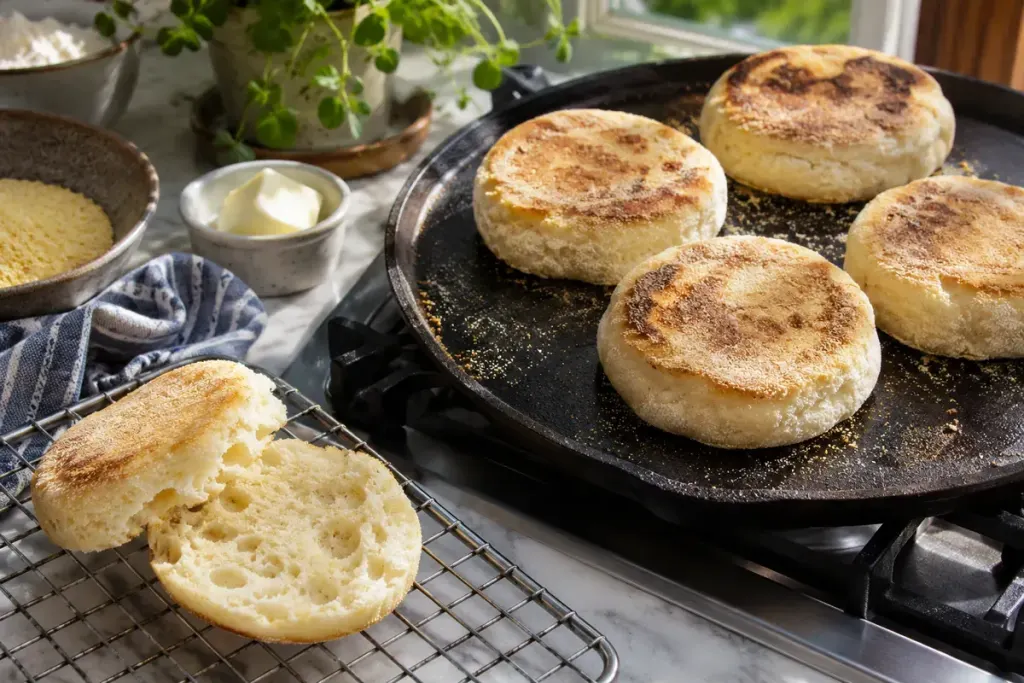
The first English muffin can be a useful test of the griddle. Lift it gently and look underneath: is the surface colouring gradually, or has a dark patch appeared while the sides still look raw? That small observation is more helpful than turning up the heat because breakfast is running late.
English muffins are yeast breads commonly cooked on a griddle. King Arthur Baking’s English muffin method uses gentle griddle heat and checks the sides as well as the browned faces. Follow a complete tested recipe for the dough and cooking sequence; this article is a guide to observing that cooking stage.
Give the first few muffins room
A crowded pan makes it harder to inspect and turn each piece. For a first attempt, choose a manageable batch and keep a clear landing place for cooked muffins. Have the recipe open before the dough reaches the hot surface so you are not trying to read instructions with a spatula already underneath it.
Record three things in your kitchen notebook: the pan used, the hob setting and the appearance when you turned the first muffin. “Medium-low” is a useful instruction, but the same dial position on another cooker is not a measurement of an identical surface temperature.
Colour is one clue
A browned face alone does not settle whether the middle is cooked. Use the doneness checks specified by your recipe, including an internal temperature where it provides one. If the outside is racing ahead, reassess the heat rather than repeatedly pressing the muffin flatter.
Let the finished bread cool as directed before opening a test piece. For the familiar uneven interior, a fork can help separate the halves without making the smooth cut a knife produces. Keep that comparison separate from the cooking check: a rough surface is a texture choice, not proof of doneness.
On the next batch, change one practical variable at a time. A calmer heat setting or a less crowded griddle gives you something clear to compare with the note you made today.