
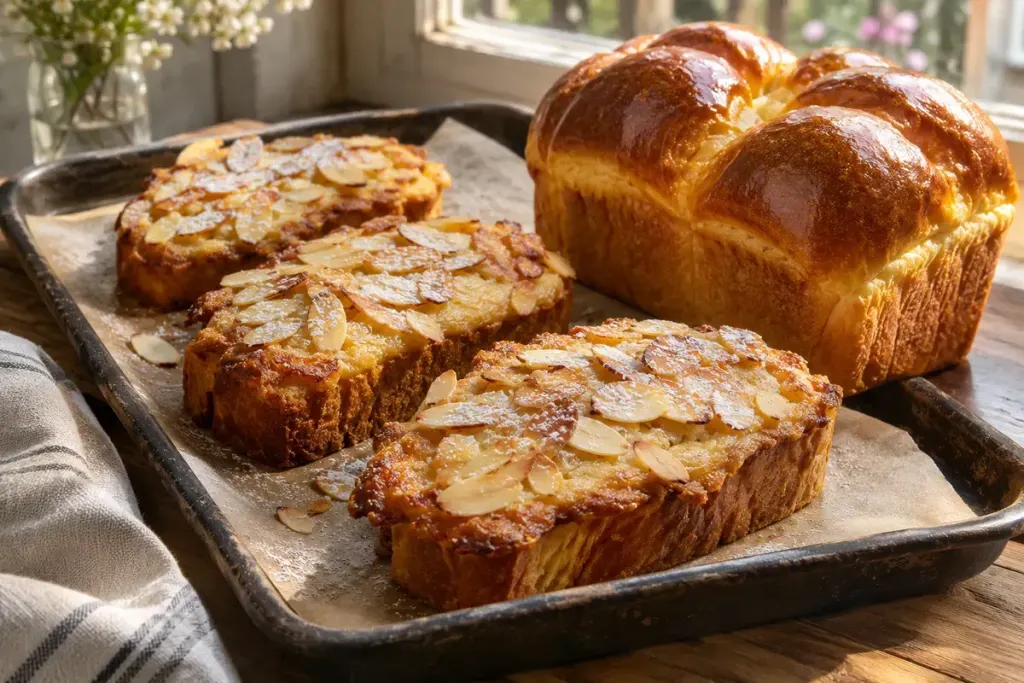
A slightly dry brioche loaf still has something to offer beyond toast. Bostock gives thick slices a second visit to the oven, with syrup and almond cream creating a pastry-like top over a soft bread base. The interest is in the contrast: browned edges, a tender middle and almonds that have had time to toast.
King Arthur Baking’s strawberry bostock provides a tested version using brioche, challah or milk bread with frangipane. Follow a complete recipe for quantities, baking temperature and storage; the notes here help organise the process rather than replace those instructions.
Think in layers before starting
The bread is the foundation. Slice it evenly so pieces on the same tray behave similarly. A very thin slice leaves little room for a moist centre, while an unusually thick one changes the balance with the topping. Bread that is a little stale can be useful; bread showing mould or spoilage is not an ingredient to rescue.
Set out the syrup and almond cream separately. It is easy to lose track of which slices have been brushed when a tray is crowded. A simple assembly order—bread first, syrup next, cream last—makes the work calmer. Keep any raw-egg mixture away from ready-to-eat food and do not taste it uncooked.
Let the first tray teach you something
Use the recipe’s doneness cues as well as its time range. Note whether the edges, centre and almond topping reach the intended finish together. If a batch is disappointing, record the bread thickness and topping amount before changing the oven setting next time.
Serve a slice on a plate where the cut edge can be seen. That cross-section explains the bake better than a heavy covering of icing sugar. Once the basic layers make sense, choose a tested fruit variation rather than adding so much wet topping that the original balance disappears.