
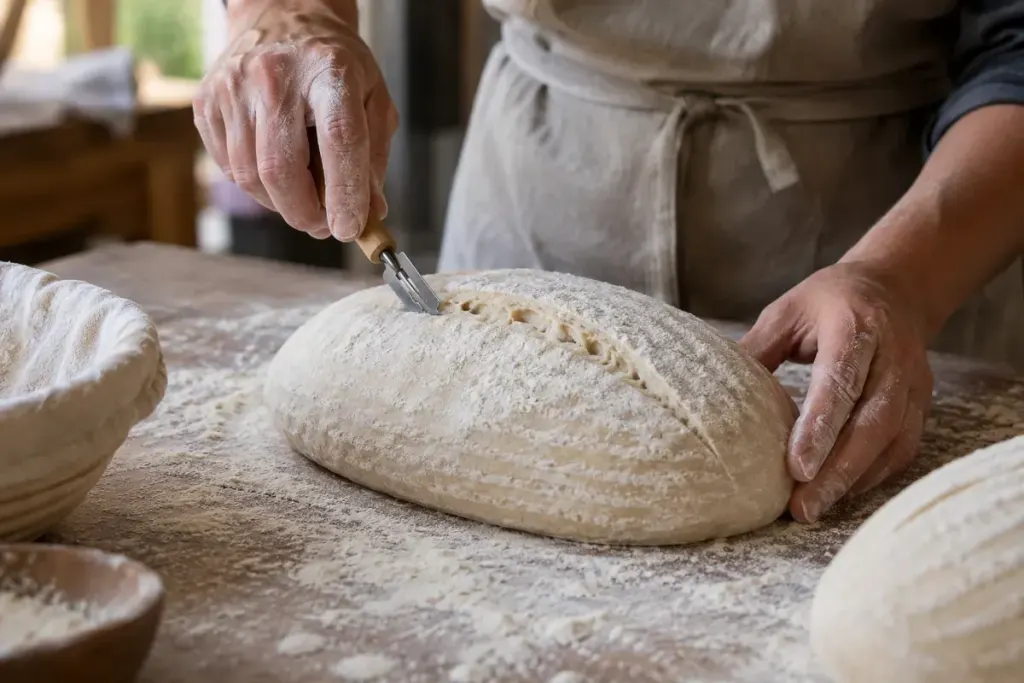
A loaf can arrive at the oven looking smooth and leave with a split along its side. The dough expanded, but its weakest opening was not where the baker expected. Scoring gives that expansion a more deliberate route.
King Arthur Baking’s scoring trials compare cuts made with different tools and approaches. The practical point is that a score is a functional opening in the dough’s surface, not merely a pattern to photograph.
Give the main cut a clear job
For a loaf whose recipe calls for scoring, identify its main expansion cut before adding decoration. Small shallow marks may create a pattern but do not necessarily provide the same release as the principal cut. Follow the recipe’s shape, timing and scoring guidance rather than copying a design from a differently shaped loaf.
Use a suitable sharp bread lame or the specified tool on a stable work surface, keeping fingers clear of its path. A hesitant sawing motion can drag the surface. A controlled, confident stroke is easier to assess afterwards than several overlapping attempts to deepen the same line.
Read the whole loaf after baking
In a useful home trial, keep the dough formula, loaf size and baking setup unchanged, then alter only the scoring approach. Photograph the unbaked cut and the finished opening. Record where an unexpected tear appeared and whether the dough seemed slack, tight or difficult to cut.
Do not assign every misshapen loaf to the blade. Fermentation, shaping, surface tension and oven conditions also influence expansion. A deep cut cannot repair every earlier problem, and a neat decorative pattern is not proof that the crumb will be well developed.
For the next bake, choose one question: did the main opening stay distinct, did the blade drag, or did the loaf burst elsewhere? That turns scoring practice into a repeatable observation. Once the functional cut behaves reliably with your recipe, decoration becomes a more manageable addition.