
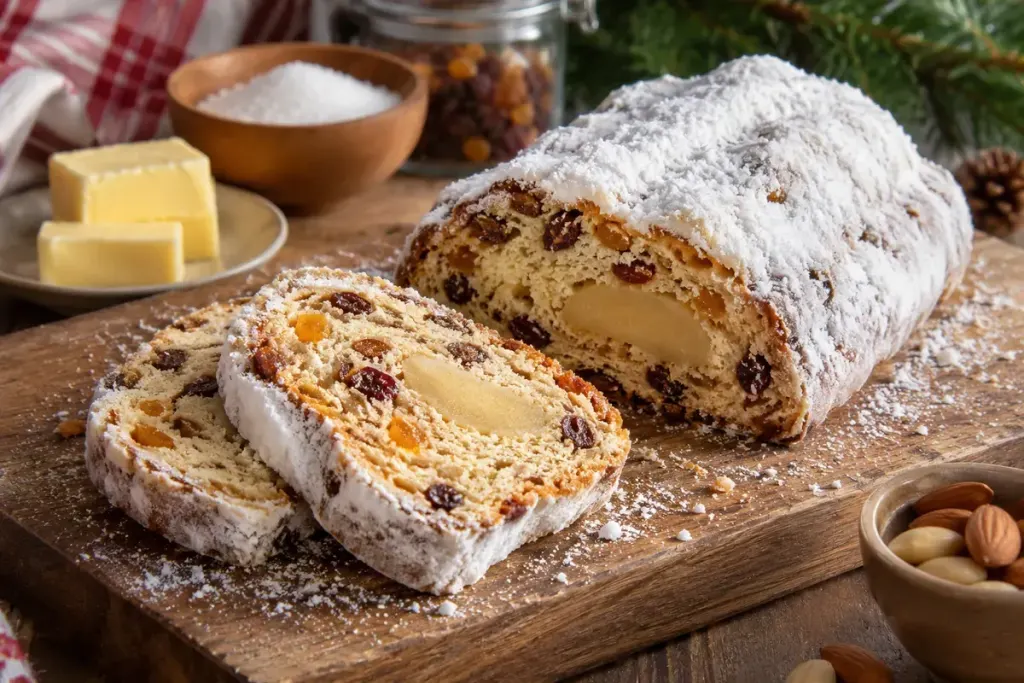
The oven timer rings, but a stollen is not necessarily finished. Its pale coat is a separate stage of the bake, and treating that stage as an afterthought can leave a patchy loaf, a sticky wrapper or a kitchen covered in sugar.
Stollen recipes vary: some use yeast, some use a quicker dough, and marzipan is not compulsory in every version. Follow the finishing method attached to the recipe you actually baked. The timing and quantities are part of that method, not a universal formula to borrow from another loaf.
What the coating contributes
Butter carries flavour and helps the sugar adhere. Different sugars behave differently on that surface. King Arthur Baking’s stollen finishing discussion distinguishes the initial sugar coating from the snowy final dusting and notes that ordinary confectioners’ sugar can dissolve over time. A fresh dusting before serving may therefore be a presentation step rather than a repair.
Do not judge the entire bake by the whiteness of yesterday’s sugar. A loaf can have an even, properly applied finish while moisture and butter gradually change its appearance.
Set up the finishing station before baking ends
Put a rack over a tray, lay out the brush and sugar, and read the cooling instructions again. This is easier than balancing a hot loaf while looking for a sieve. Brush deliberately around the curved sides; dumping butter on the top alone makes it difficult to see which areas were coated.
For a first attempt, jot down three observations: when the butter went on, when the sugar went on, and whether the loaf was fully cool before wrapping. Those notes are more useful next time than writing only “needed more icing sugar”.
Wrap for the recipe, not for the photograph
Steam trapped in a wrapper can change the surface you just finished. Let the recipe’s cooling stage run its course, then follow its storage guidance, taking account of fillings and your kitchen conditions. A butter-and-sugar coat is not a food-safety guarantee or permission to keep any homemade loaf for weeks. Cut a modest slice, notice the fruit, crumb and coating together, and decide whether the final dusting needs adjusting for serving.