
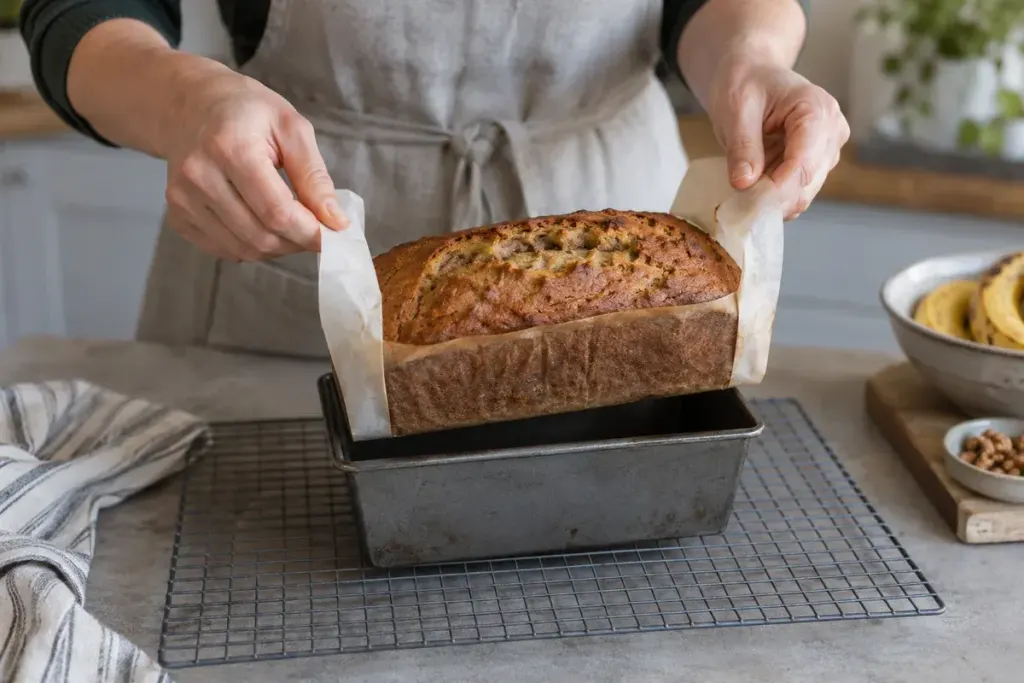
A bake can release perfectly from the base and still be difficult to lift without breaking. A parchment sling gives your hands something to hold, provided you fit it before the batter goes in.
Cut a strip that covers the pan’s base and two opposite sides, with enough extra paper to grasp. Press the folds into the corners rather than allowing a rounded paper pocket to take up space. The King Arthur Baking demonstration shows how this arrangement makes bars and quick breads easier to remove.
Fit the paper to the job
For a loaf pan, a strip across the short dimension usually leaves the two long sides as lifting handles. Check whether the recipe also requires greasing the exposed ends. For a square pan, two crossing strips can help cover more surfaces, but bulky overlaps may mark the bottom of a delicate bake. A single fitted sheet with folded corners may suit that recipe better.
Do a dry rehearsal: place the empty pan on a stable surface and lift the two handles. If one is much shorter, reposition the paper now. Trim excessive overhang so it cannot flop toward a heating element; follow the parchment manufacturer’s temperature and appliance restrictions. Waxed paper is not a substitute for baking parchment.
Release is a cooling decision too
A sling does not make a hot, fragile cake strong. Follow the recipe’s cooling instructions, loosen exposed edges gently if needed, and lift evenly over a nearby board. If the bake bends in the middle, support it rather than pulling harder.
For your next familiar recipe, note the strip width and pan dimensions on the recipe page. That tiny record makes preparation repeatable without turning every baking session into another round of measuring and trimming.