
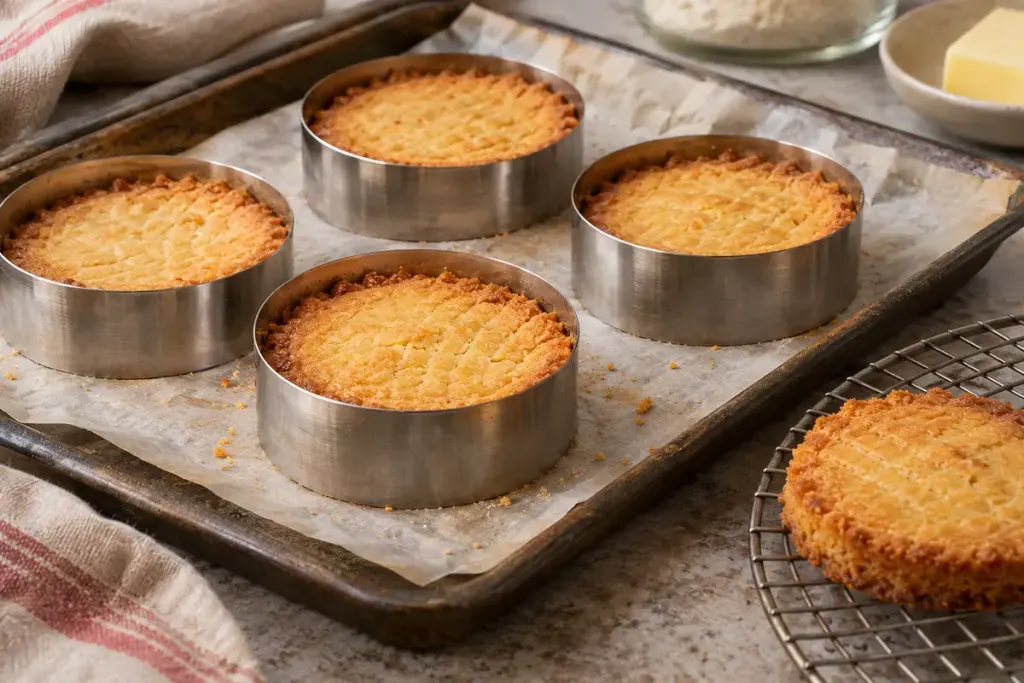
A thick Breton sablé looks simple until a neat circle of dough spreads into an irregular biscuit. In ring-baked versions, the metal is part of the method: it contains the dough while the edges set, producing a defined base that can carry fruit, cream or a more elaborate dessert.
Chef Philippe Vancayseele’s sablé Breton tart base for Callebaut uses butter, yolks and baking powder, then places the chilled, cut dough inside a cake ring. That is a useful reference for the technique, rather than a rule that every Breton biscuit must use the same mould.
Match the ring to the recipe
A wide tart base and a small individual biscuit have different distances from edge to centre. Changing the diameter while keeping the same oven time can leave you comparing unlike bakes. Start with the ring size and dough thickness specified by the recipe you actually intend to follow.
- Check that the ring is oven-safe and sits flat on the baking tray.
- Roll to a reasonably even thickness; a thin patch can colour before the rest.
- Keep the dough chilled as instructed so it is manageable when transferred.
- Follow the recipe’s guidance on greasing and release rather than assuming every metal ring behaves identically.
Judge the base before decorating it
For a useful first attempt, leave one small area visible after baking instead of immediately covering every surface with cream. Note whether the edge is evenly coloured and whether the cooled centre has the texture you wanted. A photograph of the undecorated base is often more helpful for the next bake than a picture of the finished topping.
If the result is wrong, change one meaningful variable at a time. Record ring diameter, thickness and actual baking time together. The aim is a reliable pastry foundation; an attractive circle alone cannot tell you whether the centre has baked properly.