
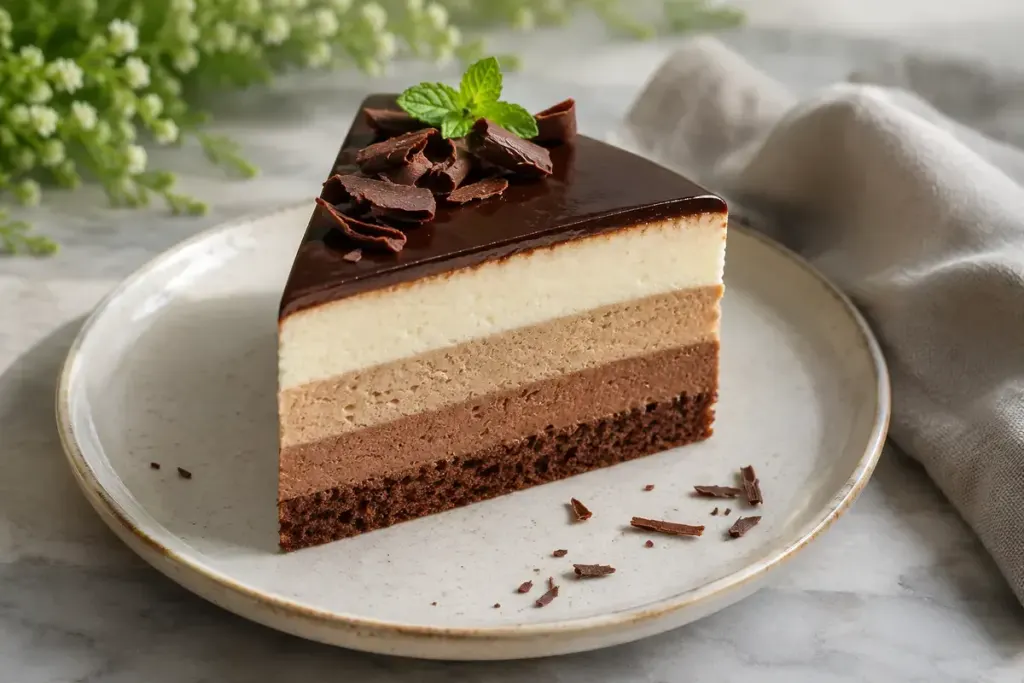
A beautiful entremets is easier to understand when you stop looking at its shiny exterior and imagine one clean slice. Where does the spoon meet softness? Which layer offers contrast? Is the base supporting the dessert or dominating it?
Sketching that slice before baking turns an impressive pastry into a sequence of manageable components. This is an assembly-planning guide; use a tested recipe for ingredient ratios, setting agents and food-safe storage.
Give each layer a reason to be there
Start with a main flavour and decide what would make it more interesting. A chocolate mousse could have a tart fruit insert and a thin sponge base. The insert supplies contrast; it does not need to compete with the mousse for thickness. Too many strong layers can make the first mouthful confusing.
Draw the mould’s approximate cross-section on paper. Leave room around an insert for mousse to form the outside wall. Note whether the chosen recipe includes a crisp component and where it belongs. Do not improvise a wet fruit layer against something intended to stay crunchy without checking the recipe’s construction.
Assembly may run in reverse
In Valrhona’s Citricchoc entremets, the prepared insert, mousse and sponge are assembled into a dessert that is frozen before finishing. Such recipes demonstrate why the order on the workbench may differ from the order visible on the plate.
Write a component list with three columns: make, cool or set, and use. A finished insert that is still too warm is not ready merely because its mixing is complete. Likewise, a glaze-ready dessert and a serving-ready dessert may be at different stages.
Plan the last hour as carefully as the first
Check that the assembled cake fits the freezer on a level tray. Allow the recipe’s specified thawing time under appropriate refrigeration, and identify a platter before unmoulding. A fragile finished cake should not have to travel between several unsuitable plates.
For a first attempt, choose fewer components and execute them well. Photograph the cut slice and record what you would change next time: a thinner base, a clearer contrast or a more evenly centred insert. That record is more useful than judging the entire cake by its gloss.