
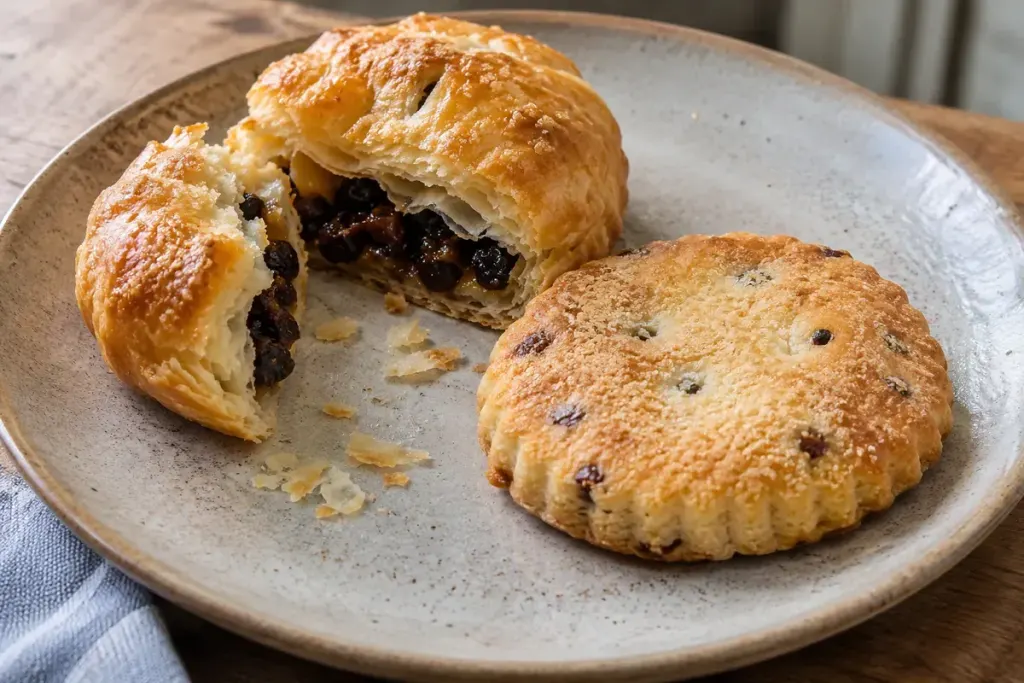
Cut into an Eccles cake and the shell breaks into flakes. A Chorley cake usually gives a shorter, more crumbly bite. Their shared dried-fruit filling makes them look related, but the pastry is the most helpful place to begin understanding the difference.
Lancashire’s Studio Bakery describes its Eccles cake as a puff-pastry bake with currants and citrus peel, and distinguishes Chorley cakes by their shortcrust pastry. Individual bakers vary the filling and finish, so those details are better treated as a starting point than a rigid authenticity test.
Let the shell guide your preparation
For the flaky version, the useful goal is to preserve the pastry’s layers. Keep the dough workable without letting it become greasy, and avoid kneading scraps back into a completely smooth ball. If a filled parcel feels soft and difficult to lift, a short rest in the refrigerator is usually a better next move than repeatedly dusting it with flour.
With shortcrust, concentrate on handling the dough only as much as necessary to bring and hold it together. A Chorley cake does not need puff pastry’s dramatic lift to be successful. Pressing it into the same expectations can lead you to overwork a perfectly suitable dough.
The filling must leave room for a seal
Whichever recipe you choose, keep fruit away from the joining edge. A mound that looks generous before folding may prevent the pastry from meeting cleanly. Make one trial parcel first: it tells you more about a sensible filling portion than dividing the entire bowl immediately.
Compare the finished pastries after they have cooled enough for their texture to settle. Notice the shell, the distribution of fruit and how sweet the finish feels. Those observations help you choose your next bake: crisp, layered pastry for one occasion, or a flatter shortcrust fruit cake for another. Neither needs to imitate the other to earn a place beside a cup of tea.