
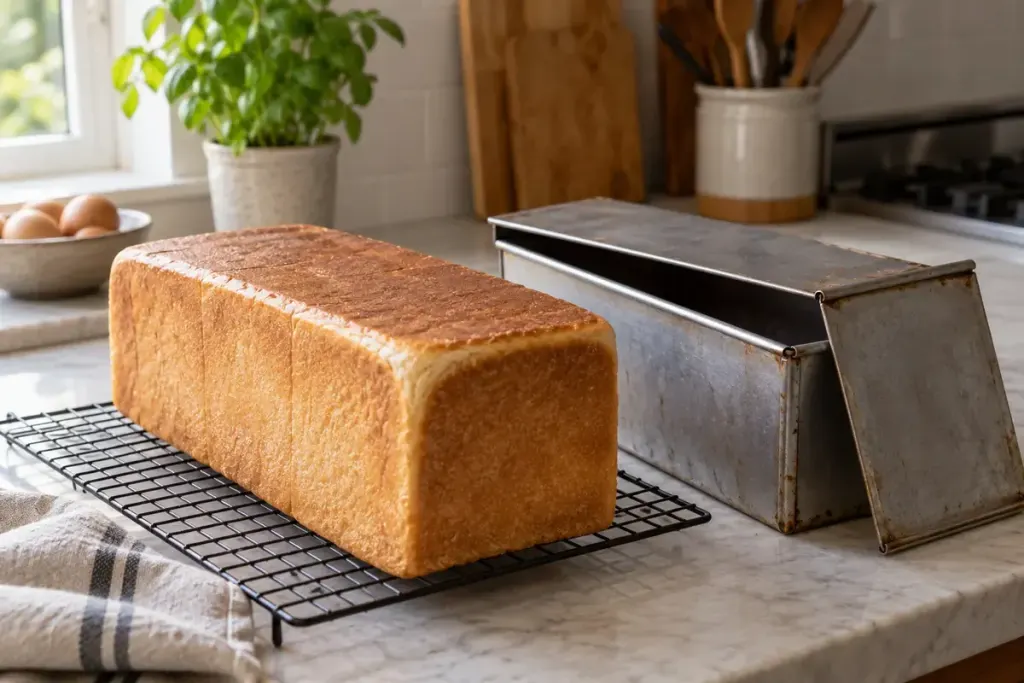
A Pullman loaf’s straight sides and flat top are useful when you want evenly shaped sandwich slices. The sliding lid does more than tidy the outline: it limits the space into which the dough can expand. An ordinary loaf recipe cannot automatically be squeezed into that space unchanged.
Begin with a recipe written for the tin
King Arthur Baking’s whole-wheat pain de mie is an example of a complete method designed for a lidded pan. Follow the specified pan dimensions, dough quantity and proofing cue together. Changing just the flour amount or choosing a tin because it looks similar can leave the dough with a different amount of headroom.
Before mixing, slide the clean lid along its track. It should move as the manufacturer intends. Finding a bent edge after the dough has risen is an awkward way to discover that the pan needs attention.
Make the final rise visible
Shape and place the dough according to the recipe, then observe its height during the final proof. The useful question is how far it has risen relative to the rim, not simply how many minutes have passed. The intended closing point belongs to that particular recipe and pan; there is no single fill line that suits every dough.
For a first attempt, write three short notes: the tin’s internal dimensions, the dough weight used and the dough’s height when the lid went on. Those details make a later adjustment more informative than “the loaf was a little small”. Keep the recipe otherwise unchanged while you learn how the pan behaves.
Use oven gloves for the hot tin and lid. If the method calls for finishing without the lid, remove it at the stated stage rather than repeatedly opening the oven to inspect the top. Release and cool the loaf as directed before slicing.
A neat square loaf is not a reason to ignore the crumb. When it has cooled, check whether the slices hold together and whether the texture suits the sandwich you wanted. The pan gives you a shape; the dough, proof and bake still have to produce the bread inside it.