
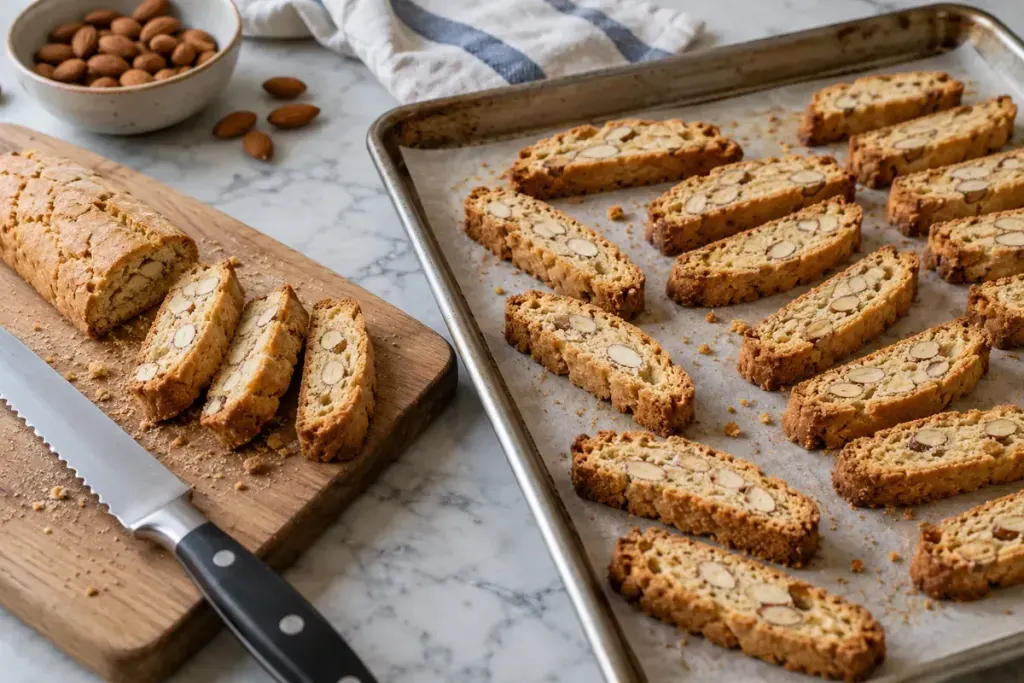
A biscotti log can look finished when it leaves the oven for the first time. Its surface has coloured and the dough holds its shape, but the centre still needs to be divided into slices before the drying stage can work evenly.
The first bake makes a structure you can cut. The second exposes those cut surfaces to heat so the slices become crisp. That division of work is more helpful than thinking of the second bake as extra time for a slightly underdone cookie.
The pause between bakes is part of the method
Follow the cooling interval in your chosen recipe. Cutting a fragile, very hot log can compress it; leaving some formulations until completely cold can make slicing harder. King Arthur Baking’s biscotti guide discusses slicing and the drying purpose of the second bake. Its advice belongs with the dough formula rather than becoming a universal timer for every biscotti recipe.
Move the log to a stable board and use a suitable serrated knife with a controlled sawing motion. Keep fingers away from the cutting line. Aim for consistent thickness, including the bottom edge: wedge-shaped pieces dry unevenly and may fall over when a recipe asks you to stand them upright.
Long diagonal slices look elegant, but they are also more delicate to move. For a first attempt, a modest angle is easier to handle. Keep the end pieces; they provide a useful early taste once cool.
Judge one cooled slice
Arrange the slices as the recipe directs, leaving space for air and turning them if required. Colour alone is an imperfect stopping signal, especially with cocoa or dark spices in the dough. Cool a test piece before deciding that the whole tray needs longer: hot biscuits can feel softer than their final texture.
For a useful baking note, record slice thickness, the second-bake arrangement and the cooled result. “Too hard” becomes easier to investigate when you know whether the slices were unusually thin or the drying stage ran longer than planned.
Cool the batch fully before storage so trapped steam does not undo the crispness. Next time, change one element—slice thickness or drying time—rather than rewriting the entire recipe after one tray.