
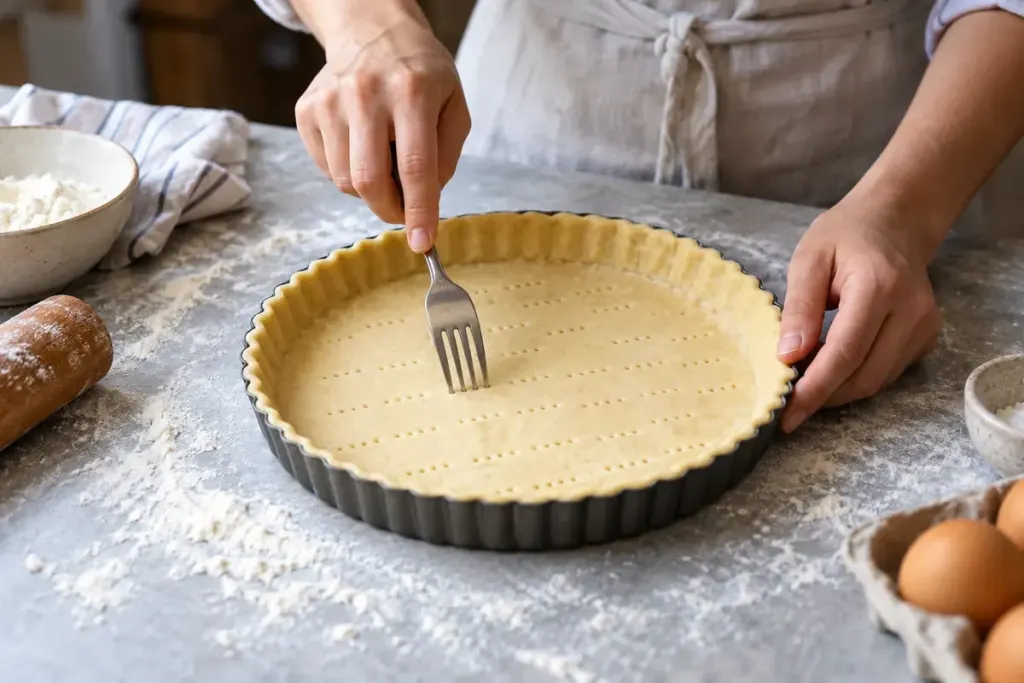
The tart base rises into a dome while the edges stay in place. A fork was sitting nearby, but the recipe never seemed clear about whether to use it. Docking means making small holes in pastry; the useful question is which result those holes are meant to produce.
For a worked example, see King Arthur Baking’s blind-baking guide. Use its method with the relevant pastry recipe rather than borrowing an isolated step.
A flat base and a puffed lid have different jobs
In a base intended to stay relatively flat, docking provides routes for steam to escape. In pastry intended to rise into distinct layers, indiscriminate pricking can work against the effect you want. Follow the method for the particular pastry and dish rather than treating a fork as an automatic step in every bake.
Blind-baking instructions may also call for a lining and baking weights. Those support the shape and press against the pastry in a different way. Docking is not a reason to ignore the recipe’s chilling, weighting or baking stages.
Think about what will sit above the holes
A very liquid filling can find a route through a poorly prepared shell. Check whether the recipe calls for an undocked base, a fully baked shell, a sealing step or another approach. Do not add extra holes just because the first attempt leaked: investigate how the shell was baked and whether it was damaged during handling.
For a practice comparison, use spare pastry from the same batch. Bake two small samples at the same thickness under the same conditions, docking only one if that is appropriate for the dough. Label your notes with the pastry type and observe the shape, surface and texture. Small samples teach a mechanism; they do not replace the instructions for a filled tart.
When the recipe does call for docking, make an even pattern without gouging the pastry or scraping a coated tin. Keep the dough cool enough to handle as intended, and work carefully around the sides rather than repeatedly stretching them.
A good tart base comes from several choices working together. The fork has a specific job, and knowing that job helps you decide when to pick it up—and when to leave the pastry intact.