
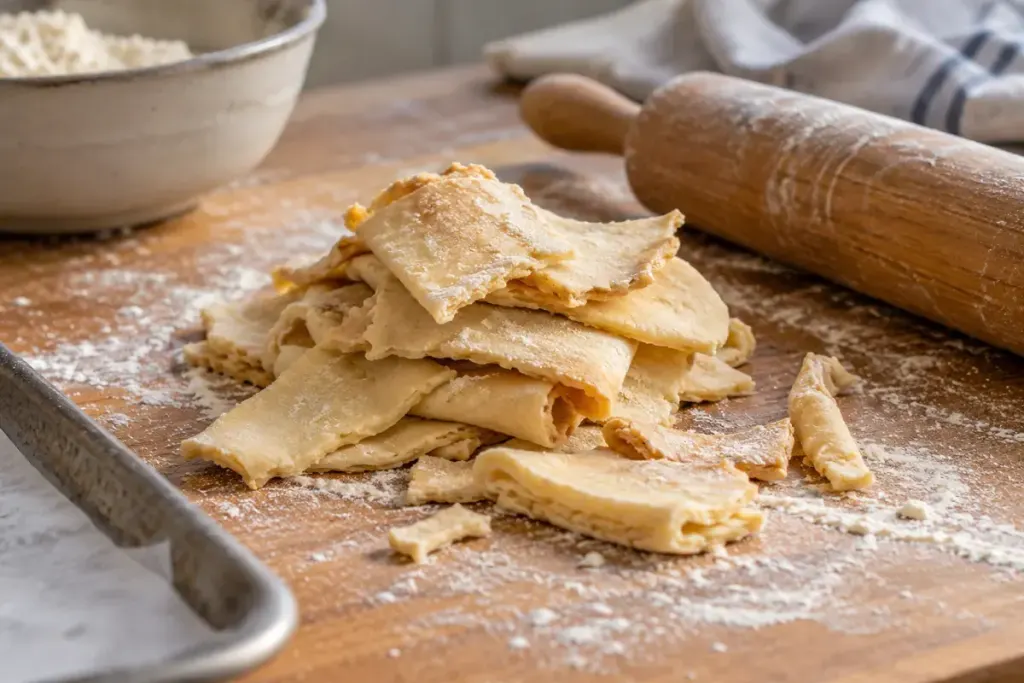
The tart is lined, but a ring of pastry remains on the counter. Those offcuts can become a worthwhile second bake if you first notice what kind of dough you have and how much it has already been handled.
Do not put every scrap into one ball
Shortcrust and laminated pastry need different decisions. Shortcrust scraps can usually be gathered gently into a compact piece for a modest reroll, following the recipe’s chilling guidance. Repeated kneading and extra flour can change their texture. Keep the second project small enough that you do not need to roll, cut and gather the same dough several more times.
For puff or other laminated pastry, preserve the visible stack of layers as far as practical. Lay compatible scraps together instead of kneading them into a smooth ball. The resulting pieces may rise unevenly, so choose informal shapes rather than a display pastry that depends on matching height.
Let the leftovers choose the project
A few broad shortcrust pieces might become small baked shapes to serve alongside fruit. Narrow puff-pastry strips suit simple twists. These are suggestions for shape, not complete recipes: use a tested recipe’s baking conditions and suitable topping quantities for the dough you are using.
Separate scraps contaminated with raw filling from clean offcuts. Do not leave dough sitting out while you finish the main bake; follow its storage and food-safety requirements. Label stored scraps with the dough type and date so they do not become an unidentified lump later.
Make one test piece when the dough has been heavily handled. Let it cool enough to judge the texture, rather than deciding from colour alone. If it is tougher than the original batch, you have learned something useful about this dough’s tolerance for rerolling.
The second bake does not need to imitate the first. A crisp, irregular biscuit can be a better use of a small remainder than forcing it into another perfect tart shell.