
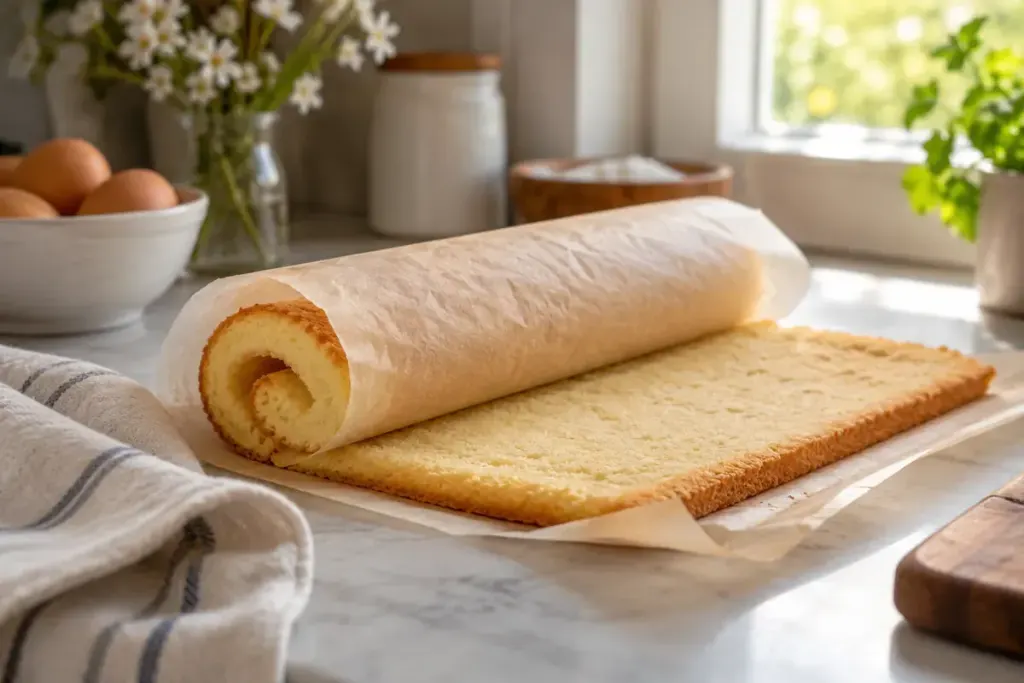
The sponge comes out of the oven, and the filling is still waiting in the refrigerator. This can be exactly the right order. Some rolled cakes need their first turn while warm, with no filling inside, so they cool in a curved shape.
It is not a rule for every sponge. In its account of making a rolled Christmas cake, King Arthur Baking describes warm pre-rolling and also notes that a sufficiently moist chocolate sponge can use a different method. Read the complete recipe before deciding which sequence to follow.
Prepare the landing place before baking
A hot tray is an awkward moment to search for another sheet of paper. Have the prescribed towel or parchment, a clear work surface and a cooling space ready. Check which edge the recipe tells you to start from: rolling from the short side produces a different shape from rolling along the long side.
For a first attempt, keep the original pan size. Changing the tin changes the layer thickness, and a thick layer may not bend like the thin sponge shown in the method. Record the tin dimensions beside your baking notes rather than relying on “the rectangular one”.
Support the sponge instead of pulling it
Follow the recipe’s release and dusting instructions. Use the paper or towel to support the movement, letting the cake curve gradually. Pulling directly on a delicate edge can damage it before the rest of the sponge starts to move.
If a crack appears, pause and inspect it. A small surface split and a cake that has broken into separate sections call for different expectations. Do not keep tightening the roll in an attempt to hide a structural break; an alternative layered dessert may be the more attractive result.
Let the pre-rolled sponge cool as directed, then unroll only enough to add the filling. A chilled cream filling should not be spread onto a cake that is still giving off heat. Keep the filling layer even and leave the margin specified in the recipe.
For the next bake, note three things: how the surface felt when it left the oven, how the first turn behaved and whether the filled cake held its shape. Those observations make a more useful adjustment guide than simply adding more filling to cover a crack.