
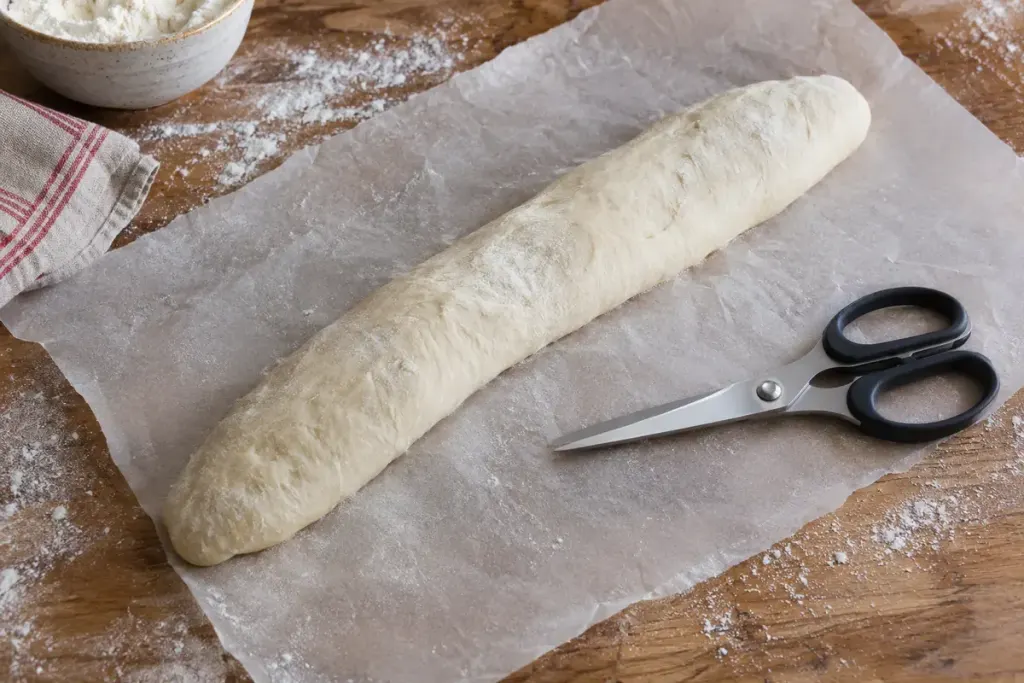
The appealing part of a pain d’epi is not a special mould. It is the way a baguette-shaped piece of dough opens into alternating ears. Each ear becomes an easy portion to tear away, with more crust around its edges than a plain uncut baton.
Use a dough and baking schedule you already trust. This is a shaping exercise, so changing the flour, hydration and fermentation at the same time makes the result harder to understand. The King Arthur test kitchen’s epis de ble recipe shows the basic operation: low-angle scissor cuts go most of the way through the loaf, and the cut sections move to alternate sides.
Give the shape somewhere to go
Before cutting, look at the tray rather than the dough. A long, narrow space that fits a baguette may not fit the finished zigzag. Place the loaf on the surface from which it will be baked or transferred, leaving space on both sides. Moving a fully cut, soft loaf later can pull the ears out of position.
- Use clean kitchen scissors that open comfortably across the dough.
- Make one decisive cut, keeping the base connected.
- Move that section gently to one side.
- Repeat at a similar interval, directing the next section the other way.
Follow the chosen recipe for when cutting happens relative to proofing and for oven settings. Different methods place that step at different points; borrowing the shaping photograph from one recipe and the entire schedule from another can create an avoidable mismatch.
For your first attempt, aim for four or five clearly separated ears rather than a highly elaborate loaf. After baking, photograph it from above. Did adjacent ears merge? Did one cut sever the base? Was the final ear much smaller? Those observations give the next loaf one specific improvement. Let the bread cool appropriately before judging the crumb or packing portions for later.