
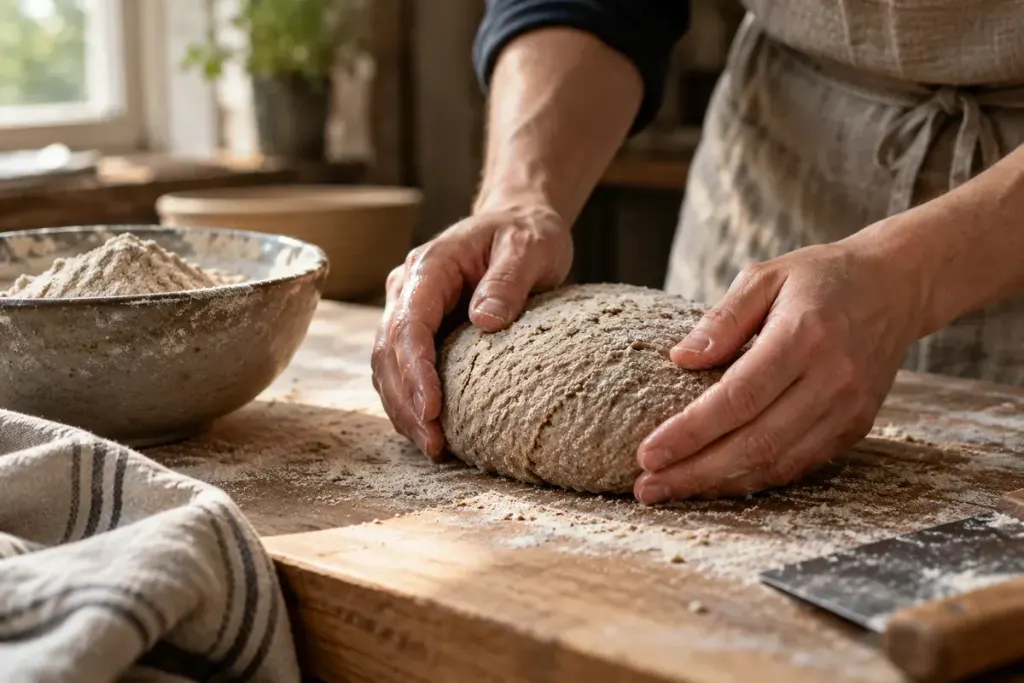
A rye dough can cling to the scraper after the point when a white bread dough would feel smooth and elastic. It is tempting to keep kneading or dusting the bench until the familiar texture appears. With rye, that familiar texture may be the wrong target.
King Arthur Baking’s rye tutorial explains why rye-heavy dough needs different handling from wheat dough. Rye does not build the same gluten structure as wheat. That does not make rye gluten-free; it means the behaviour of the dough cannot be judged by a wheat-only benchmark.
A loaf containing a small proportion of rye and plenty of strong wheat flour is a different project from a predominantly rye loaf. Read the entire formula, including flour in a starter or preferment, before deciding how much strength you expect to develop.
For your first comparison, keep a short bench note with three entries: the flour mixture, the dough’s texture at the end of mixing, and how you handled it during shaping. This gives the next bake a useful starting point without turning every sticky moment into a reason to change the recipe.
Make handling easier without rewriting the dough
Use the recipe’s recommended tools and handling method. A scraper can move dough cleanly, while lightly dampened hands can help with some rye formulas. Avoid repeatedly pouring in flour simply to make the worktop feel dry: that changes the formula as well as the handling.
Pause if you find yourself chasing a dramatic stretch or a tight, balloon-like skin. Check the recipe’s actual mixing and shaping cues. A supported loaf in a tin may have a very different finish from a freestanding wheat boule.
Once baked, give the loaf the cooling and resting time its recipe specifies before evaluating the crumb. Record one change for the next attempt rather than changing flour, water and mixing together. A rye loaf becomes easier to understand when its own behaviour is the reference.